NozeDex · nozedex.com/guide
Free guide · read it here, no sign-up
How to buy a perfume you’ll actually wear
Most disappointing bottles were judged too fast: in the first minute, on a paper strip, in a shop full of other smells. Here is what your nose and skin are doing, how to test before you pay, and a short checklist.
What your nose and skin do
Five things the research supports. Each one’s source is listed at the end of the page.
Your nose tunes out a smell that doesn’t change
Smelling the same odour for a while lowers your sensitivity to it, and it comes back once the exposure stops. So after a while you notice your perfume less than the people around you do. Don’t spray more for that: step away into fresh air for a while, then smell again. 1
Some people can’t smell some musks
Not being able to smell a particular musk at all is documented in smell research. If a friend says your perfume smells of nothing, it may truly be so for them. Ask more than one person. 2
Each material leaves your skin at its own speed
How fast a fragrance material evaporates from skin depends on how volatile it is, how well it dissolves in the skin’s oils, and on air flow and temperature. The top, heart and base on a box are a simplified picture of that. Judge a perfume after its opening, not in the first minute. 3
Skin isn’t a paper strip
Skin is warm and carries its own oils; a paper strip has neither, so the same perfume can smell and last differently on you. Use strips to shortlist, and decide on skin. 4
Formulas change
In the EU, atranol and chloroatranol, natural parts of oak moss and treemoss extracts, may not be in cosmetics placed on the market from 23 August 2019, so formulas that relied on them had to change. If an old favourite smells different, check when your bottle was made. 5
How to test before you buy
Not lab findings: a routine that follows from them.
- Shortlist on paper strips, then put no more than two perfumes on skin per visit, one on each wrist.
- Ignore the first minutes. Leave the shop, smell your skin again later, and again a few hours on.
- Before a full bottle, wear a sample or a decant for a whole day, on a cool day and a warm one if you can.
- Ask someone else to smell it on you, and check that the name, the concentration and the size are the ones you tried.
Before you pay
If any answer is no, buy a sample first.
- Has it been on my skin for a full day, not just on a strip?
- Did I smell it after the opening, away from the shop?
- Did someone else smell it on me?
- Is it the same name and concentration I tried, not a flanker or another version?
- If it’s a rebuy, do I know when this bottle was made?
- Do I trust the seller, and have I compared the price?
In the app
Do it in NozeDex
The app keeps this routine in one place, from the first smell to the bottle check. Free, in beta.
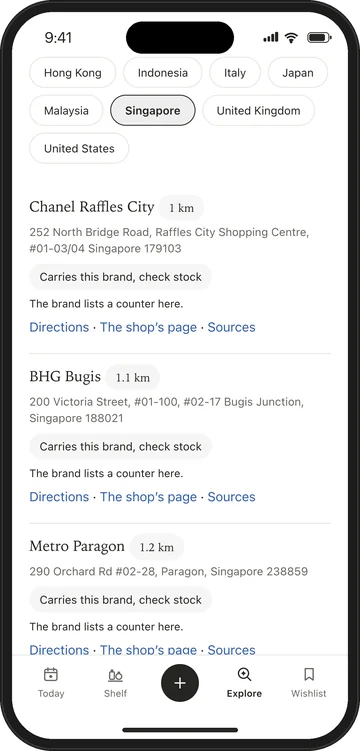 Where to smell itShops near you that carry it.
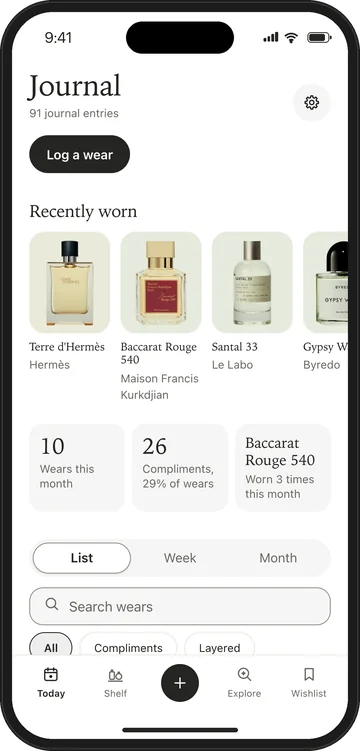 Log each wearSamples and decants too, with your notes.
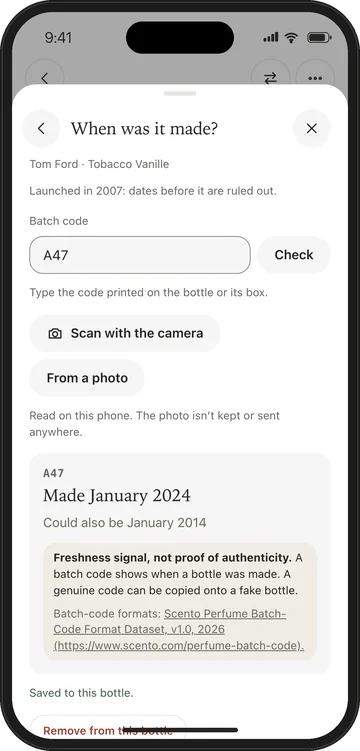 When was it made?Date the batch code before a rebuy.
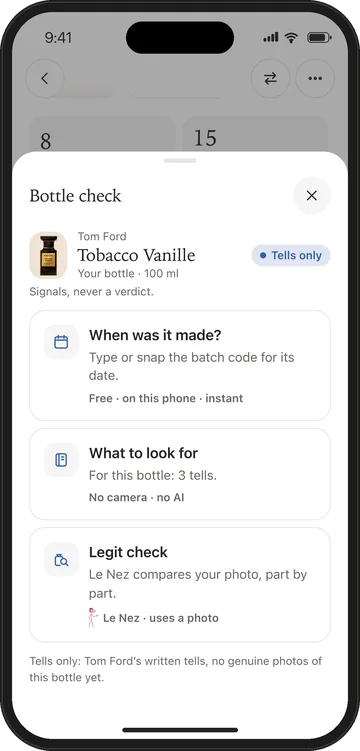 Bottle checkWhat to look for, and a legit check with Le Nez.
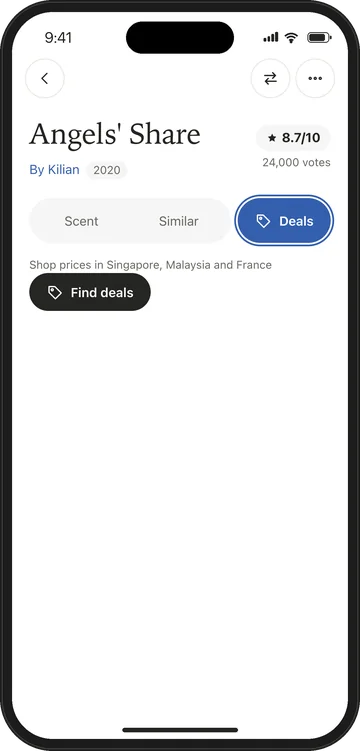 Find dealsPrices at shops for a perfume on your wishlist, when you ask.
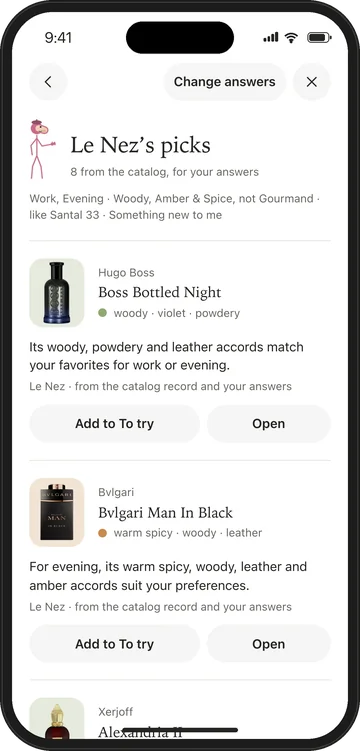 Find with Le NezNot sure what to try? A few questions, picks with reasons.
The screens show a sample collection.
- iPhone: Open this on your iPhone in Safari · install TestFlight first · iOS 16.4 or later
- Android: join the tester group with the Google account on your phone, then opt in on Google Play (how)
Sources
- Pamela Dalton, “Psychophysical and Behavioral Characteristics of Olfactory Adaptation”, Chemical Senses 25(4), 487-492, 2000. doi.org/10.1093/chemse/25.4.487
- D. Whissell-Buechy and J. E. Amoore, “Odour-blindness to musk: simple recessive inheritance”, Nature 242, 271-273, 1973. doi.org/10.1038/242271a0
- G. B. Kasting and P. Saiyasombati, “A physico-chemical properties based model for estimating evaporation and absorption rates of perfumes from skin”, International Journal of Cosmetic Science 23(1), 49-58, 2001. doi.org/10.1046/j.1467-2494.2001.00079.x
- “Insight into how skin changes perfume”, International Journal of Cosmetic Science 18, 237-246, 1996. doi.org/10.1111/j.1467-2494.1996.tb00154.x
- Commission Regulation (EU) 2017/1410 of 2 August 2017, amending Annexes II and III to Regulation (EC) No 1223/2009 on cosmetic products. eur-lex.europa.eu/eli/reg/2017/1410/oj
Written by the NozeDex team from these sources; titles are as published. Where the guide gives a routine instead of a finding, it says so. Spot a mistake? Write to us and we’ll fix it: hello@nozedex.com
General information
This guide is general information about perfume, not medical advice: if a perfume irritates your skin, stop using it. NozeDex isn’t affiliated with any perfume house; brand and perfume names belong to their owners.